How can we understand enzyme behavior in an environment as complex as the plant cell wall? By visualizing enzyme movement in model systems using the DISCO beamline at the SOLEIL synchrotron!
Project synopsis
The CLICTEAM project focused on developing a model of the plant cell wall, composed of concentrated suspensions (> 10%) organized in a liquid crystal phase, in order to understand the behavior of an enzyme under these complex conditions. The system includes cellulose nanocrystals and a hemicellulose, xyloglucan. Glucanase, an enzyme whose substrate is xyloglucan, was then introduced into these model systems and localized by fluorescence microscopy accessible on the DISCO beamline of the SOLEIL synchrotron. We were able to show that the “flat” adsorption of short xyloglucan chains on cellulose had a strong impact on glucanase. This adsorption modifies the interaction between cellulose and the enzyme from attractive to repulsive, causing the enzyme to migrate to the least concentrated regions of our models and significantly accelerating its diffusion. This result could be linked to an optimization of enzyme use in real conditions, in planta.
Project description
The use of enzymes for biomass offers many advantages in the development of the bioeconomy. Indeed, they are generally used under fairly mild physical and chemical conditions (temperature/pressure close to ambient, reaction in aqueous conditions) and do not require the use of other products, thereby limiting their environmental impact. Enzymatic processing also benefits from a wide range of enzymes. Like a toolbox, each enzyme is adapted to a substrate, enabling a large number of reactions. Enzymes thus provide access to a wide range of possible reaction products. Understanding how enzymes act on biomass is therefore an important objective, both from a fundamental and applied perspective. Studying this also provides a better understanding of the behavior of enzymes naturally present in plants.
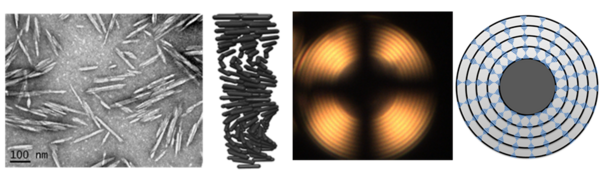
This study is generally conducted under model and diluted conditions in order to facilitate understanding of the mechanisms observed. Unfortunately, these conditions may be far removed from those prevailing in the plant cell wall, which can lead to a lack of transferability of the results to real-life conditions. This was the first challenge of this project, which aimed to develop a simplified model of the plant cell wall (PCW) with certain characteristics identified as essential, namely: a high solid content (above 10%), a multiscale organization, and the integration of at least two polysaccharides naturally present in the PCW. The model we have chosen consists of cellulose, which is the main biopolymer in PCW, in the form of cellulose nanocrystals (CNC), which are the basic nanoparticles of cellulose. When these CNCs are prepared in the form of high-concentration aqueous suspensions, they form a liquid crystal phase known as cholesteric (Figure 1, left), thus providing a concentrated and organized system, as desired. The second polysaccharide added is xyloglucan (XG), a water-soluble hemicellulose whose interaction with cellulose has been the subject of numerous studies by the NANO team and which plays a crucial role in PCW. These organized suspensions were studied in the form of droplets because their very small volume reduces the amount of enzyme required (see Figure 1, right).
Figure 1. From left to right: TEM image of CNCs; three-dimensional structure of the cholesteric organization of CNCs; appearance of an organized CNC droplet and its schematic representation.
The action of the enzyme in these model systems was studied by monitoring the degradation products, but also from a colloidal perspective to understand its diffusion in concentrated media. This latter study was conducted jointly by the NANO and PVPP teams in collaboration with ESPCI - Paris (experts in microfluidics and liquid crystals) and the SOLEIL synchrotron. We needed to locate the enzyme in the droplets without modifying it with markers that could potentially impact its enzymatic activity. This is the specialty of SOLEIL's DISCO beamline, which uses a far-ultraviolet (DUV) source to quantify the concentration of species in fluorescence microscopy without chemically labeling them, taking advantage of the autofluorescence of proteins excited at these wavelengths.
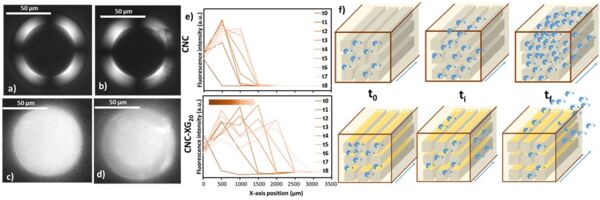
We therefore prepared customized microfluidic devices, allowing observation of the distribution of the enzyme under study, a glucanase whose substrate is XG, in the droplets. Such experiments on large instruments required lengthy work to develop the experimental device. Initial observations on suspensions without XG showed a homogeneous distribution of glucanase in the droplets. A surprising result was the observation of an interaction between glucanase and CNCs, even though the latter are not its substrate. However, we observed that in the presence of XG, the enzyme concentrated in the less concentrated core of the droplets (Figure 2, a-d). At the same time, experiments involving the diffusion of the enzyme in these suspensions showed that the enzyme diffused much more rapidly in CNC suspensions containing XG (Figure 2, e)2. Initially puzzling, this result was explained by correlating it with quartz microbalance experiments, which showed a much more significant interaction of the enzyme on CNCs than on CNCs covered with XG (CNC-XG). The results obtained on DISCO therefore stem from a difference in the nature of the interaction between glucanase and CNC (attractive) compared to glucanase on CNC-XG (repulsive). The enzyme then diffuses towards the more diluted center of the droplets. Thus, enzymes diffusing in concentrated CNC suspensions remain “stuck” to their surface and therefore diffuse less far and less quickly than in CNC-XG suspensions (Figure 2, f).
Figure 2. a, b) polarized light appearance of CNC and CNC-XG droplets, respectively; c), d) distribution of the enzyme in the same droplets, localized by DUV fluorescence microscopy; e) diffusion profile of the enzyme in CNC and CNC-XG suspensions, and f) schematic representation of this diffusion.
This surprising result therefore implies that glucanase interacts more strongly with bare cellulose than with cellulose covered with XG. It is important to note that the XG chosen adsorbs “flat” to the surface of the cellulose and is not accessible to enzymatic action. Its influence on enzyme behavior therefore stems more from competition between the enzyme and XG to interact with the cellulose surface. This highlights the important role of this type of flat-adsorbed XG in PCW, which can modulate enzyme diffusion without necessarily being the substrate.
(1) Voisin, H.; Bonnin, E.; Marquis, M.; Alvarado, C.; Lafon, S.; Lopez-Leon, T.; Jamme, F.; Capron, I. Interactions between Proteins and Cellulose in a Liquid Crystalline Media: Design of a Droplet Based Experimental Platform. Int. J. Biol. Macromol.2023, 245 (January). https://doi.org/10.1016/j.ijbiomac.2023.125488.
(2) Voisin, H.; Bonnin, E.; Marquis, M.; Alvarado, C.; Lafon, S.; Lopez-Leon, T.; Jamme, F.; Capron, I. Probing the Colloidal Behavior of a Cell Wall Polysaccharides-Degrading Enzyme in a Highly Constrained Model System. J. Colloid Interface Sci.2025, 694 (February). https://doi.org/10.1016/j.jcis.2025.137685.
(3) Voisin, H.; Vasse, A.; Bonnin, E.; Capron, I. Influence of Low-Molar-Mass Xyloglucans on the Rheological Behavior of Concentrated Cellulose Nanocrystal Suspensions. Biomacromolecules2023, 24 (1), 358–366. https://doi.org/10.1021/acs.biomac.2c01172.
(4) Voisin, H.; Vasse, A.; Bonnin, E.; Cousin, F.; Capron, I. Tuning of the Chiral Nematic Phase of Cellulose Nanocrystals by the Adsorption of a Short Polymer on Their Surface. Cellulose2023, 30 (13), 8299–8309. https://doi.org/10.1007/s10570-023-05385-4.
By browsing our site you accept the installation and use cookies on your computer.
Know more
Our use of cookies
Cookies are a set of data stored on a user’s device when the user browses a web site. The data is in a file containing an ID number, the name of the server which deposited it and, in some cases, an expiry date. We use cookies to record information about your visit, language of preference, and other parameters on the site in order to optimise your next visit and make the site even more useful to you.
To improve your experience, we use cookies to store certain browsing information and provide secure navigation, and to collect statistics with a view to improve the site’s features. For a complete list of the cookies we use, download “Ghostery”, a free plug-in for browsers which can detect, and, in some cases, block cookies.
You can also visit the CNIL web site for instructions on how to configure your browser to manage cookie storage on your device.
In the case of third-party advertising cookies, you can also visit the following site: https://www.youronlinechoices.com/fr/controler-ses-cookies/, offered by digital advertising professionals within the European Digital Advertising Alliance (EDAA). From the site, you can deny or accept the cookies used by advertising professionals who are members.
It is also possible to block certain third-party cookies directly via publishers:
Cookie type
Means of blocking
Analytical and performance cookies
Realytics Google Analytics Spoteffects Optimizely
Targeted advertising cookies
DoubleClick Mediarithmics
The following types of cookies may be used on our websites:
Mandatory cookies
Functional cookies
Social media and advertising cookies
These cookies are needed to ensure the proper functioning of the site and cannot be disabled. They help ensure a secure connection and the basic availability of our website.
These cookies allow us to analyse site use in order to measure and optimise performance. They allow us to store your sign-in information and display the different components of our website in a more coherent way.
These cookies are used by advertising agencies such as Google and by social media sites such as LinkedIn and Facebook. Among other things, they allow pages to be shared on social media, the posting of comments, and the publication (on our site or elsewhere) of ads that reflect your centres of interest.
Our EZPublish content management system (CMS) uses CAS and PHP session cookies and the New Relic cookie for monitoring purposes (IP, response times). These cookies are deleted at the end of the browsing session (when you log off or close your browser window)
Our EZPublish content management system (CMS) uses the XiTi cookie to measure traffic. Our service provider is AT Internet. This company stores data (IPs, date and time of access, length of the visit and pages viewed) for six months
Our EZPublish content management system (CMS) does not use this type of cookie.
For more information about the cookies we use, contact INRAE’s Data Protection Officer by email at cil-dpo@inra.fr or by post at:
INRAE 24, chemin de Borde Rouge –Auzeville – CS52627 31326 Castanet Tolosan cedex - France